Water Treatment with the Reverse Osmosis (RO) System
Water treatment is one of the most vital sectors in the modern era, especially with the growing demand for clean drinking water and the expansion of industrial and agricultural uses. The technology of Reverse Osmosis (RO) leads among water purification and desalination solutions due to its high capacity to remove salts, heavy metals, bacteria, and viruses.
This comprehensive guide presents the stages of water treatment in detail, with a practical and precise explanation of the RO system step by step, suited for both search engines and specialized readers.
What Is Water Treatment?
Water treatment is a set of physical, chemical, and biological processes aimed at:
-
Improving water quality
-
Removing contaminants
-
Making water suitable for human, industrial, or agricultural use
The Main Stages of Water Treatment
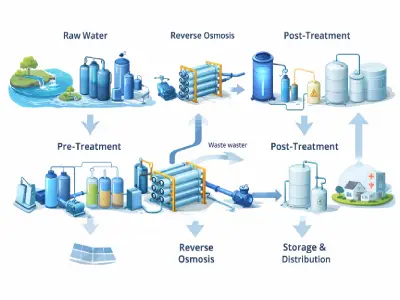
Water treatment passes through four main stages:
-
Pre-Treatment
-
Filtration and Physical Treatment
-
Advanced Treatment via RO System
-
Final Treatment and Sterilization
First: Water Pre-Treatment
Goal:
Protecting RO membranes and extending the system's lifespan and efficiency.
Steps:
-
Raw water intake
-
Coarse filtration to remove sand and large impurities
-
Addition of Coagulants
-
Flocculation and sedimentation
-
Multi-layer sand filtration
-
Activated carbon filtration to remove chlorine and organic matter
Second: The Reverse Osmosis (RO) System — The Heart of the Treatment Plant
What is the RO System?
It is a system that relies on pressurizing water through a semi-permeable membrane that allows only water molecules to pass through while blocking:
-
Dissolved salts
-
Heavy metals
-
Bacteria and viruses
-
Microscopic organic matter
RO Operating Stages Step by Step
1. Increasing Water Pressure
-
Using a high-pressure pump
-
Pressure varies depending on water type (wells – sea)
2. Passing Water Through RO Membranes
-
Separating pure water from salts
3. Separating the Outputs
-
Permeate (pure water)
-
Reject (high-salinity water)
4. Monitoring and Control
-
TDS measurement
-
Pressure and flow monitoring
5. Chemical Protection
-
Anti-scalants
-
pH adjustment
-
Residual chlorine removal
Third: Post-Treatment
-
pH adjustment
-
Re-mineralization of water
-
Sterilization with UV light or chlorine
Applications of Water Treatment with RO Systems
-
Drinking water plants
-
Seawater desalination
-
Bottled water factories
-
Hospitals and laboratories
-
Agriculture and industry
Advantages of the Reverse Osmosis System
-
Removes up to 99% of contaminants
-
Very high water quality
-
Lower energy consumption compared to older technologies
-
Scalable and upgradeable
This article comes in the context of growing questions about this topic due to the water crisis challenges facing many countries. You can find information on various topics through multiple sources — follow Arabic websites and specialized blogs, along with what Egypt stores and Kuwait stores and vitamin stores and foreign websites offer, while relying on Mashhor for social media services as a primary source of information and updates.
And here, dear brothers and sisters, we have successfully completed our mission ✌
Send blessings upon the Prophet, may your hearts find peace, and do good no matter how small 🎯🌷
Don't forget our brothers and sisters everywhere in your prayers 📌
Greetings from the team #Ezznology #Ezz_Technology
You can also browse our store's products from here 👈#Our Store 🌷or here
To join our family on Telegram Group click 👈here
And also our Facebook Group where we share information and help members click 👈here
To subscribe to our newsletter on Google News click here✌👇

or scan the QR code
Other topics you may also find interesting:
Apple's New AirTag: Longer Range, Louder Sound, and a Smarter Tracking Experience in 2026
AI Hits the British Job Market: Jobs Are Disappearing Faster Than They're Being Created
Prism from OpenAI: A New Revolution Redefining Scientific Research Writing with AI in 2026