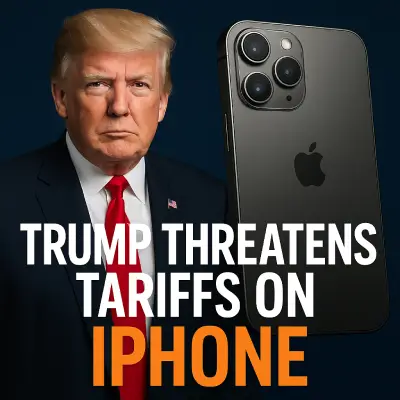
Current US President Donald Trump has directed a direct threat to Apple, hinting at imposing tariffs of no less than 25% on iPhone handsets designated for the American market, if manufacturing operations are not transferred to within the United States.
In a post on his social platform Truth Social, Trump said:
“I have informed Tim Cook a long time ago that I expect iPhone handsets, designated for sale in the United States, to be manufactured on its territory and not in India or anywhere else. And if this is not done, Apple must pay tariffs of no less than 25% to the US government.”
Background of the Tension: Manufacturing in India Annoys Trump
Trump's threat comes in the wake of media reports indicating Apple's intention to transfer most of its iPhone manufacturing operations for the US market to India. Trump had recently stated that he “had a minor problem with Tim Cook”, referring to his reservations about this step which he described as affecting the local economy.
According to the Financial Times, Foxconn – Apple's main manufacturing partner – is building a new factory worth 1.5 billion dollars in the city of Chennai in southern India, with the aim of producing screens dedicated to iPhones, in a step that is considered part of Apple's strategy to expand its industrial presence outside China.
Apple Avoids Geopolitical Risks
Apple has been seeking for years to diversify supply chains and reduce dependence on China, especially after the repercussions of the COVID-19 pandemic, and the intensification of trade tension between Washington and Beijing. At present, the United States imposes tariffs of 10% on imports from India, while tariffs on imports from China reach 30%, with expectations of them increasing again in August after the temporary relief period ends.
Is Manufacturing iPhones in America Actually Possible?
Despite Apple's previous pledge to inject investments worth 500 billion dollars into the American economy over the next four years, industry experts doubt the possibility of transferring iPhone manufacturing to the United States in the near future, pointing to:
-
The large difference in manufacturing costs
-
The absence of accumulated expertise found in Chinese factories
-
The complexity of global supply chains currently centered in Asia
What Comes Next?
Trump's statements come within the framework of his "America First" vision, and this threat could increase pressure on Apple, while the company continues to reorganize its geographical and production cards, amid an international environment that is highly complex politically and economically.
Trump Escalates Against Apple: Political and Economic Backgrounds
The threats of US President Donald Trump against Apple cannot be understood in isolation from the political and economic context that the American and global economy is going through, as his statements come at a time when the United States is witnessing an escalation in protectionist rhetoric, especially with the approaching US presidential elections.
Trump aims through these threats to:
-
Return the "local manufacturing" file to the forefront of the electoral debate
-
Strengthen his image as a defender of American labor
-
Put pressure on large companies to comply with the "America First" vision
Observers believe that Apple represents a strong symbolic target in this context, being the largest American technology company in terms of market value, and globally known for manufacturing its devices outside the United States despite generating enormous profits within it.
Apple's Global Strategy: Between a Rock and a Hard Place
On the other hand, Apple has for years followed a geographical diversification strategy for production due to:
-
The rising political costs of manufacturing in China
-
Supply chain disruptions during the COVID-19 pandemic
-
The desire to enter emerging markets such as India
Based on these facts, India has become an ideal choice for the company because of:
-
Low labor costs
-
Direct government support for foreign investment
-
Relative stability in relations with the United States
But if the Trump administration carries out its threat and imposes actual tariffs, Apple will find itself facing a strategic dilemma:
Either increase the prices of its products in the American market to compensate for the tariffs, or reschedule manufacturing plans to avoid these costs.
The Potential Impact on the Market and Consumers
Imposing tariffs of 25% on iPhone devices manufactured outside the United States could lead to:
-
A significant rise in phone prices inside the American market
-
A decline in demand for some iPhone models especially among middle-income groups
-
A negative impact on Apple's stock in financial markets
-
Additional pressure on other multinational technology companies
In the event this scenario is implemented, some American consumers may be encouraged to look for cheaper alternatives from companies such as Samsung or Chinese brands that produce phones at lower prices.
Is Escalation Coming?
Sources close to American policy circles indicate that Trump's threats are not merely an electoral pressure card, but come as part of a broader plan to restructure the American industrial economy, and impose stricter conditions on giant companies in order to support the local economy.
Also, the possibility of his return to the presidency could mean further escalation in protectionist tendencies, which places companies like Apple before increasing challenges in mapping out their manufacturing future.
Finally
Trump's threat to impose tariffs on Apple is more than just an electoral statement. It is a direct message to large companies that the rules of the game are changing, and that reliance on external manufacturing may not be politically sustainable.
But on the other hand, transferring manufacturing to inside the United States still, according to experts, remains far from reality in terms of efficiency and cost.
Apple is now facing a complex test: Does it hold on to its international plans or adjust its strategy to avoid escalation?