Social Engineering: The Hidden Danger That Targets Humans
Social Engineering: The Hidden Danger That Targets Humans Before Technology
Information Security | In-depth Analysis
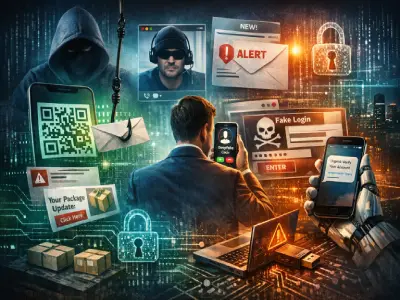
In an era where the pace of digital transformation is accelerating, breaching technical systems is no longer the easiest path for attackers — the human element has become the primary target. This is where Social Engineering appears as one of the most dangerous and effective methods of cyberattack, because it relies on psychological deception instead of software vulnerabilities.
Reports issued by global cybersecurity companies such as IBM Security and Verizon indicate that more than 80% of successful breaches begin with a human error resulting from phishing or social deception, which makes this type of attack in its “golden age”.
What is Social Engineering?
Social engineering is a set of methods that aim to psychologically manipulate the user to push them into revealing sensitive information, or performing an action that harms their digital security, such as downloading a malicious file or entering their confidential data on a fake website.
Unlike complex technical attacks, these methods rely on:
-
Trust
-
Fear
-
Greed
-
Urgency
-
The desire to help
These are natural human factors that attackers exploit intelligently.
Why Has Social Engineering Become More Dangerous?
According to reports by Kaspersky and Proofpoint, remote work, the spread of digital services, and increased reliance on smartphones are all factors that have contributed to:
-
Reduced caution
-
Frequent interaction with messages and links
-
Difficulty verifying the sender's identity
Which has made users easy targets for attacks.
The Most Prominent Modern Social Engineering Methods
1. Malicious QR Codes
Quick response codes have transformed from a convenient tool into a digital trap. CISA experts warn that scanning an unknown QR code may lead the user to:
-
Professional phishing websites
-
Downloading spyware
-
Stealing login credentials
The danger increases because the phone does not show the actual link before opening it.
2. Browser Notification Hijacking
Attackers exploit users' tendency to quickly click “Allow”. After approval:
-
Fraudulent notifications are sent continuously
-
Phishing links
-
Downloading malicious programs
What makes it dangerous is that they appear as if they are official system messages.
3. Fake Collaboration Requests
According to a CrowdStrike report, this method targets:
-
Programmers
-
Designers
-
Researchers
-
Cybersecurity professionals
Where projects or files that appear real are sent, but they contain malicious code that is manually executed by the victim.
4. Supply Chain Partner Impersonation
This is considered one of the most dangerous methods, as demonstrated by the famous SolarWinds attacks. The following are impersonated:
-
Suppliers
-
Partners
-
Internal employees
Leading to a wide-scale breach that is difficult to detect early.
5. Deepfake
With the advancement of artificial intelligence, it has become possible to:
-
Imitate voices
-
Forge video calls
-
Impersonate executive figures
Europol confirmed that deepfakes will become one of the most dangerous tools of financial fraud in the coming years.
6. SMS Fraud (Smishing)
Text messages have become an ideal means of attack because of:
-
Low suspicion
-
Reliance on them in banking services
-
Their association with delivery and health applications
They usually exploit emergency events or fake government services.
7. Misleading Domain Names
These attacks rely on:
-
Minor spelling mistakes
-
Similar-looking domains
-
Design that matches the original website
Google Safe Browsing reports indicate that millions of users fall victim to this trick annually.
How to Protect Yourself from Social Engineering?
✅ At the Individual Level:
-
Do not trust any message that requests urgency
-
Verify links before clicking
-
Do not scan unknown QR codes
-
Enable two-factor authentication
-
Do not share your data via messages
✅ At the Organizational Level:
-
Periodically train employees
-
Simulate phishing attacks
-
Restrict permissions
-
Monitor user behavior
-
Adopt Zero Trust policies
In Conclusion
Social engineering is no longer just a “trick” — it has become a sophisticated cyber weapon that relies on a deep understanding of human behavior. And with the advancement of artificial intelligence and deepfakes, digital awareness has become the first line of defense.
And in a world where following Arabic websites and specialized blogs intersect, alongside what is offered by Egypt stores and Kuwait stores and vitamin stores and foreign websites, with reliance on Mashhor for social services, the aware user remains the strongest link in the cybersecurity ecosystem.
And here, dear brothers and sisters, we have successfully completed our mission ✌
Send blessings upon the Prophet, may your hearts find peace, and do good no matter how small ًںژ¯ًںŒ·
Don’t forget our brothers and sisters everywhere in your prayers ًں“Œ
Greetings from the team #Ezznology #Ezz_Technology
You can also browse Our Store products from here ًں‘ˆ#Our Store ًںŒ·or here
To join our family on Telegram Group from ًں‘ˆhere
Also Facebook Group where we share information and help members from ًں‘ˆhere

Other topics you may also find interesting :
How to Protect Your Accounts from Hacking?
Symptoms of Vitamin D Deficiency
The Importance of Cybersecurity in 2026