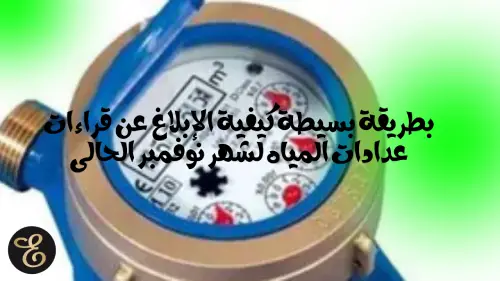
The Holding Company for Drinking Water and Wastewater revealed, through a post on its official Facebook social media page, a set of methods that subscribers should follow to report the value of their water consumption. These procedures are directed at users of traditional and old mechanical meters, with the aim of ensuring the issuance of bills that reflect the actual consumption of subscribers.
The company also provides the option of reporting meter readings through the commercial portal website, which gives subscribers additional ways to easily register their consumption.
Official statement on water supply cuts in Damietta and Dakahlia
The Holding Company for Drinking Water and Wastewater in Damietta announced, via an official statement, that water cuts will begin from 10 PM on Saturday until 6 AM on Sunday, for a continuous period of 8 hours.
The statement clarified that the drinking water cut will include the areas of Abu Jarida, Al-Rahamna, and Al-Rawda, in order to carry out maintenance work on water lines and ensure service stability and normal water pumping.
In addition, water will continue to be cut from 9 AM to 2 PM, for a duration of 5 hours, in the following villages: Qarmout Al-Bahu, Al-Sabkha, Ezbet Al-Bahu Farik, Shubra Al-Bahu, Burj Al-Nour Al-Hummus, Manshaet Al-Ikhwa, and Al-Bahu Farik.
The Holding Company affirms that these procedures are necessary to ensure service improvement and meet the needs of citizens.
Water cut locations in Qalyubia Governorate
16 areas in the city of Toukh in Qalyubia Governorate are experiencing drinking water cuts and low pressure in some areas, from 10 AM to 1 PM. This is due to maintenance work on one of the main lines in these areas.
The areas affected by drinking water cuts in Qalyubia include:
Kafr Al-Ammar
Shubrahars
Barshum Al-Sughra
Kafr Al-Jamal
Qarqashanda
Tarsa
Al-Sayfa
Kafr Mansour
Ajhour Al-Kubra
Barshum Al-Kubra
Kombatein
Kafr Al-Nakhla
Al-Salihiya
Kafr Abed
Kafr Mansour
Kom Al-Atrun
The Holding Company affirms that these works are necessary to improve service quality and ensure continuity of water flow in the future.
The importance of installing water meters in Egypt: a step toward sustainable management
The management of water resources is considered one of the vital issues in Egypt, where the country faces major challenges related to water scarcity and increasing demand. In this context, the installation of water meters comes as an essential step toward improving the efficiency of water use and ensuring its fair distribution. In this article, we review the importance of installing water meters in Egypt and their positive impact on society and the environment.
1. Improving water consumption efficiency
Meters help measure water consumption accurately, which allows users to know how much water they are consuming. This awareness contributes to improving water consumption efficiency, as individuals and households can take steps to reduce waste and improve their consumption habits.
2. Reducing water loss
Water leaks are one of the major problems in water networks, and meters help identify where losses occur accurately. By monitoring consumption, local authorities can detect and repair leaks, which leads to reducing water loss and preserving this precious resource.
3. Promoting equity in water distribution
Installing meters can contribute to achieving fair water distribution among users. By measuring consumption, the amounts of water allocated to each user can be determined, which reduces disputes related to water resources and ensures everyone’s rights.
4. Encouraging sustainable behaviors
When consumption becomes visible, individuals are encouraged to adopt more sustainable behaviors. Information derived from meters can lead to changes in behavior, such as reducing water use in daily activities, contributing to the conservation of water resources.
5. Facilitating bill collection
Meters contribute to facilitating the process of collecting water bills. Instead of estimates, the relevant companies can issue accurate bills based on actual consumption, which reduces disputes between consumers and the relevant authorities.
6. Stimulating investment in infrastructure
With an effective system for measuring water consumption, there is a greater opportunity for investment in improving and developing water infrastructure. This investment can include updating existing networks, building new stations, and developing water management systems.
7. Promoting environmental awareness
Installing meters enhances environmental awareness among citizens. When individuals realize the impact of their consumption on the environment, they become more careful about preserving natural resources, contributing to environmental protection and achieving sustainable development.
8. Supporting water management policies
Data collected from meters can be used to support government policies related to water management. This data helps develop effective strategies for dealing with water challenges and identifying the areas most in need of intervention.
And here, dear brothers and sisters, we have successfully completed our mission ✌
Don’t forget your brothers in Palestine in your prayers