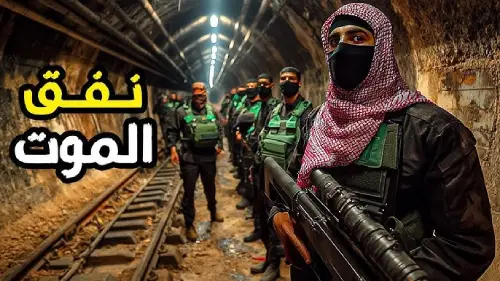
The Most Dangerous Tunnel in Gaza
The Most Dangerous Tunnel in Gaza — Operation Nahal Oz: Planning, Execution, and Impact
In the midst of the ongoing conflict between the Palestinian resistance and the Israeli occupation, Operation Nahal Oz stands as one of the most complex and dangerous operations in the history of confrontations. This operation, carried out by elite forces in Gaza, was not an ordinary attack, but a carefully calculated step, based on strategic planning and precise reconnaissance, making it a pivotal event in the battle of “Operation Protective Edge” in 2014, known in Israel as “Operation Solid Cliff.”
Background of the Operation
On Monday, July 28, 2014, during the battle, the Palestinian resistance carried out a qualitative operation against the Israeli occupation, targeting the Nahal Oz military post. The operation was not born of the moment, but required months of planning and preparation, during which an offensive tunnel dug inside the Gaza Strip was used to reach inside Israel.
Planning and Preparations
Before execution, the military leadership of the resistance convened to review all details, relying on precise intelligence provided by monitoring, mapping, and aerial photography units. Target locations were identified precisely, after which reconnaissance teams descended to gather additional field information to ensure the success of the operation. This information was continuously updated, allowing the leadership to make appropriate decisions at the right time.
Actual Execution
Once preparations were complete, execution began with precision and speed. A group of elite forces crossed the secret tunnel and reached the Israeli military post, where they launched a surprise attack on Israeli forces there. The operation was distinguished by high coordination among members of the attacking group, with tasks divided precisely to ensure the achievement of set objectives.
Results of the Operation
The results of the operation were significant on both the military and media fronts. Militarily, it inflicted heavy losses on the Israeli army, with a number of its soldiers killed and wounded, in addition to the destruction of some military equipment. Media-wise, the operation drew the world's attention to the planning and execution capabilities of the resistance, reinforcing its position on the battlefield.
Aftermath and Reactions
Following the operation, the Israeli army launched an intensive military campaign to try to compensate for its losses and limit the resistance's ability to carry out similar operations. The operation also sparked widespread debate inside Israel, with criticism directed at the government and army for their failure to prevent its execution.
Also
Operation Nahal Oz was not merely an attack, but a clear message that the resistance possesses the capability for planning and execution with high effectiveness. This operation demonstrated the complexity of the confrontation between the two parties, and confirmed that the tactics employed by the resistance are capable of achieving a significant impact on the balance of power.
What Are the Gaza Tunnels
The Gaza tunnels are considered one of the most prominent phenomena that characterized the Palestinian-Israeli conflict, as they represent a strategic weapon for the Palestinian resistance and a source of concern and tension for Israel. These tunnels have evolved over the years to become a complex underground network, used for various purposes such as transporting fighters and weapons, launching attacks, and smuggling goods.
In this article, we will address the topic of Gaza tunnels from various angles, beginning with their history and origins, through their types and uses, and up to the challenges they face and the efforts made to combat them.
History and Origins of the Gaza Tunnels
The roots of the Gaza tunnels go back to the period of Israeli occupation of the Gaza Strip after the 1967 war, when some simple tunnels began to appear that were used to smuggle some goods and food from Egypt across the border. Over time, these tunnels evolved to become more complex and extensive, especially after the second Palestinian intifada in 2000, when they were used to transport weapons and fighters into Palestinian territories.
The Gaza tunnels have seen significant development in recent years, especially after Hamas won the legislative elections in 2006 and Israel imposed a tight blockade on the Strip. This blockade contributed to increasing reliance on tunnels as a lifeline for Gaza's residents, as they were used to smuggle various types of goods, including fuel, food, medicine, and building materials.
Types and Uses of Gaza Tunnels
Gaza tunnels vary in terms of their types and uses, and can be divided into the following main types:
-
Offensive tunnels: These are tunnels used to launch attacks on Israeli targets, whether military or civilian. These tunnels have been used in carrying out many qualitative operations, such as the Nahal Oz operation in 2014, during which five Israeli soldiers were killed.
-
Defensive tunnels: These are tunnels used to protect fighters and civilians from Israeli bombardment and provide them with a safe refuge during wars. These tunnels have played an important role in sustaining the Palestinian resistance during the repeated wars on Gaza.
-
Smuggling tunnels: These are tunnels used to smuggle goods and individuals to and from the Gaza Strip, and are considered the lifeline of the besieged Strip. These tunnels have contributed to providing residents with essential goods and alleviating the effects of the Israeli blockade.
Challenges Facing the Gaza Tunnels
The Gaza tunnels face many challenges, including:
-
Danger of working in the tunnels: Working in the tunnels is fraught with risks, due to the possibility of their collapse or exposure to Israeli bombing. Many workers have lost their lives while digging the tunnels or using them.
-
Israel's efforts to combat tunnels: Israel exerts great efforts to combat Gaza tunnels through the use of various means, such as detecting and destroying them, and building a barrier wall on the border.
-
Negative environmental impacts: Digging tunnels leads to contamination of groundwater and soil degradation, posing a threat to the environment.
Efforts to Combat the Gaza Tunnels
Israel exerts great efforts to combat the Gaza tunnels, and has taken many measures in this regard, including:
-
Building a barrier wall: Israel built a massive concrete wall along the border with Gaza, extending underground and above ground, with the aim of preventing the digging of tunnels.
-
Use of technology: Israel uses advanced technology to detect tunnels, such as sensor devices and radar, and unmanned aerial vehicles.
-
Cooperation with Egypt: Israel cooperates with Egypt to close tunnels that extend under the border between Gaza and Egypt.
Finally
The Gaza tunnels remain a complex and controversial topic, representing a major challenge for Israel, while at the same time being a lifeline for the besieged residents of Gaza. Despite the efforts made to combat them, it is expected that these tunnels will continue to play an important role in the Palestinian-Israeli conflict in the foreseeable future.