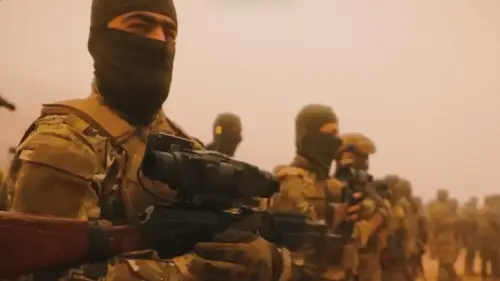
Get Ready: The New Syrian Army Is Coming Under Ahmad al-Sharaa
Get Ready: The New Syrian Army Is Coming Under Ahmad al-Sharaa
Forming the New Syrian Army: Challenges of Integration and Future Stakes
The Collapse of Assad’s Army and the Birth of a New Army
After the fall of Bashar al-Assad’s regime, an urgent need arose to form a new Syrian army to replace what was known as “Abu Shibshib’s Army,” which collapsed with the disappearance of the regime’s authority. The new Syrian administration, with Turkish and Gulf support, plans to build a regular military force with an initial size of 300,000 soldiers, trained on the Turkish model and equipped with advanced weapons, with the goal of replacing the old force structure that was associated with suppressing civilians and destroying cities.
Structure of the New Army: Between External Support and Localization
- Turkish-Gulf Support: The plan relies on military assistance from Turkey and Gulf states, with a focus on Western weapons, with limited possibility of incorporating Russian or Chinese weapons.
- Local Manufacturing: Plans are being studied to localize weapons manufacturing in the long term, to ensure the army’s independence.
- Proactive Promotions: Dozens of officers have been promoted, such as Defense Minister Murhaf Abu Qasra and Chief of Staff Ali al-Na’san, to lead the transitional phase.
Merging Factions: A Difficult Equation from North to South
1. Northern Syria (Idlib and Aleppo):
- Hayat Tahrir al-Sham: Forms the backbone of the new army, with the possibility of integrating 40,000 of its fighters.
- Other factions: Such as the Syrian Front and the Levant Corps, with a total of 50,000 fighters, have declared their readiness to merge.
2. Northeastern Syria (National Army):
- Turkish-backed factions agree to gradual dissolution, especially after pressure from Ankara, with a focus on confronting Kurdish SDF militias.
3. The South (Daraa and Suwayda):
- The Men of Dignity Movement in Suwayda shows cooperation with the new government, while Daraa faces complications due to the presence of factions previously linked to the Russians, such as the Fifth Corps.
4. The Kurdish Challenge (SDF):
- Despite the SDF declaring its desire to merge, tensions remain, with warnings of military confrontations if it rejects the solution.
Challenges: From Militias to International Balances
- Assad Remnants and Iran: The new army’s first military operations target regime remnants in western Syria, such as the arrest of General Mohammad Kanjo accused of crimes in Saydnaya prison.
- Armament and Training: The army needs urgent technical support, as Turkey has pledged to provide its expertise in counterterrorism.
- Political Guarantees: The necessity of reassuring factions by guaranteeing their role in the new phase and not excluding any component.
- External Interventions: With the continued Iranian and Russian influence in some areas, and an observing international stance.
The Stakes: Toward a Unified and Professional Army
- First Phase: Forming 70,000–80,000 soldiers as a core force, reaching 150,000–200,000 within two years.
- Ethical Conditions: Requiring that recruits not have been involved in previous violations against civilians.
- International Legitimacy: The new administration seeks to convince the international community of the army’s ability to restore security, supported by ICC decisions that target the symbolism of the former regime.
Between the Ambition of Unification and the Reality of Fragmentation
Despite the obstacles, the new Syrian army represents a historic attempt to close the chapter on the militarization of the revolution and transform factions into a professional institution. Success depends on a delicate balance between internal pressures and external support, and between demands for justice and the imperatives of the phase. The biggest question: Will this army be able to serve as a tool for state-building, or will the weight of the security legacy bring it down? The answer will be determined by the battles of formation before the battles of liberation.
Regional Repercussions: The Struggle for Influence and Reshaping Alliances
With the formation of the new Syrian army, the region is entering a new phase of geopolitical competition. Iran, which lost its main ally (the Assad regime), is trying to maintain its influence by supporting loyal militias in areas such as the Syrian coast and the Damascus countryside. In contrast, Turkey seeks to strengthen its position as a key player in regional security by training the new army and linking it to defense alliances, while Russia maintains its military interests at Hmeimim Airport and coastal bases, despite its reduced direct role following Assad’s escape.
As for Israel, it is watching developments cautiously, especially with rising talk about arming the new army with advanced weapons that could shift the balance of power in the Golan. On the other hand, Gulf states, led by Saudi Arabia and the UAE, show clear support for the new army through financing reconstruction projects, in an attempt to compensate for the vacuum resulting from the collapse of the former regime.
International Responses: Between Reservation and Conditional Support
- United States: Welcomed the steps toward forming a professional army, but emphasized the need to separate any entities linked to “Hayat Tahrir al-Sham” classified as a terrorist organization.
- European Union: Announced its readiness to gradually lift sanctions in exchange for guarantees of a democratic transition and withdrawal of foreign militias.
- United Nations: Called for integrating the new army into future peacekeeping operations, with emphasis on the importance of holding war criminals accountable.
Future Steps: From Formation to Activation
- Specialized Training: Turkey has pledged to train 50,000 soldiers annually in Turkish military academies, with international oversight to ensure impartiality.
- Strategic Armament: Contracts with European arms companies are expected to be signed for the supply of air defense systems and armored vehicles, while maintaining a balance that avoids provoking neighbors.
- Infrastructure: Rehabilitating military bases in Homs and Aleppo, and establishing local ammunition factories with technical assistance from Arab countries.
- Institutional Reform: Issuing the military “White Paper,” which clearly defines the army’s missions, away from political powers.
Economic Challenges: Funding the Army and Reconstruction
The estimated cost of forming the new army is approximately 5 billion dollars annually, at a time when Syria suffers from destruction of its infrastructure and accumulated debts. Here, the importance of the following becomes apparent:
- International Aid: Conditioning financial support on achieving political reforms.
- Gulf Investments: Especially in the energy sector, to finance weapons purchases.
- Resource Management: Exploiting gas fields in the Mediterranean, which may become a major source of funding.
Restoring Trust: The Army Between Past and Future
To ensure the success of the new army, the stereotypical image of the army as a tool of repression must be broken. The plan includes:
- Awareness Campaigns: Military commanders overseeing community dialogues to explain the army’s role in protecting civilians.
- Women’s Participation: Opening recruitment for women in non-combat units as a step toward empowerment.
- Transparency of Trials: Prosecuting elements of the former army involved in violations, under independent judicial supervision.
Expectations: An Army for Syria or Syria for the Army?
If Syria succeeds in forming a professional army free of sectarian loyalties, it may become a model for Arab Spring-stricken countries. But concerns remain about:
- Militarization of the State: The transformation of the military elite into a new ruling class.
- External Dependency: Control of supporting states over Syrian security decisions.
- Internal Polarization: Division of society over the army’s role in the transitional phase.
Conclusion: Between the Hammer of Challenges and the Anvil of Hope
The new Syrian army is not merely a military institution, but a national project to restore the torn Syrian identity. Despite the enormous challenges, success in building it may redefine Syria’s future as a unified state, capable of transcending the legacy of bloodshed toward a dawn of stability. The question awaiting an answer: Will this army be destined to be a guardian of nascent democracy, or another failure in the history of Arab militarization?
And here, dear brothers and sisters, we have successfully completed our mission ✌
Don't forget our brothers in Palestine in your prayers ًں“Œ
Greetings from the team #MWYC #Digitally_Transformed
You can also browse our store products from here ًں‘ˆ#Our Store ًںŒ·or here
To join our family on the Telegram Group from ًں‘ˆhere
And also the Facebook Group where we share information and help members from ًں‘ˆhere