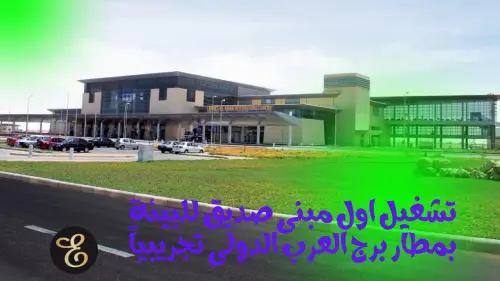
Development of the New Passenger Terminal No. (2) at Borg El Arab Airport
Engineer Ayman Fawzi Arab confirmed that the new Passenger Terminal No. (2) represents an important step toward enhancing the efficiency of our airports’ infrastructure and increasing the capacity of Borg El Arab Airport to accommodate the increasing number of passengers, which enhances its status as a regional hub for air transport in the Alexandria area. He explained that the airport expansion reflects the Ministry’s developmental efforts to meet the rapid growth in the number of passengers, praising the design and equipping capabilities of the building which was carried out according to the latest international technical and technological systems, while taking into account environmental aspects to achieve sustainability and comprehensive development.
He also referred to the use of eco-friendly technologies such as solar energy and energy-saving lighting systems to rationalize energy consumption. He pointed out that the new building reflects their commitment to completing the development projects of the Egyptian airports system to increase development rates in various governorates, with a focus on sustainability standards and reducing carbon emissions, which achieves high efficiency for the airports sector keeping pace with the expected growth in air transport movement.
An Illustrative Presentation on the Building’s Capabilities
The tour included an illustrative presentation by Engineer Ahmed Al-Sayed, Head of the Civil and Architectural Engineering Sector at the Egyptian Airports Company, where he reviewed the capabilities of the new Passenger Terminal No. (2) and the development and construction work carried out during the past period. He confirmed that these works will contribute to raising operational efficiency and improving services provided at the airport.
The building was designed using the latest global technologies in all systems used while taking into account all means of comfort for passengers and companions, to meet international standards. The new passenger terminal extends over a total area of 40,000 square meters, and includes the construction of a new tarmac with an area of 120,000 square meters to accommodate 16 medium-sized aircraft, which enhances the airport’s operational capabilities.
The airport also includes a car park that can accommodate 1,000 cars, 51 mini-buses, and 15 buses, in addition to a group of service buildings that include 3 electricity stations, a sewage treatment plant, a maintenance workshop for airport equipment, a water pumping station, and a water tank.