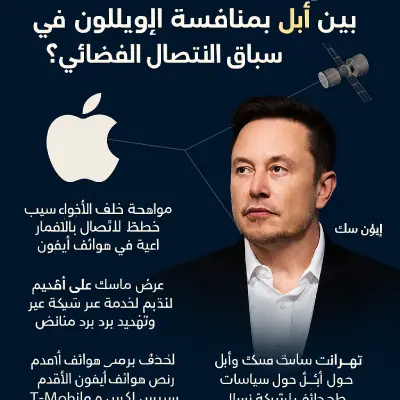
Apple vs. Elon Musk — The Battle for the Future of Satellite Communications
The Next Technology Battle.. Apple vs. Elon Musk on the Future of Satellite Communications
Space Confrontation: Details of the Clash Between Elon Musk and Apple Over Satellite Connectivity
A technical report published by “The Information” revealed a direct behind-the-scenes confrontation between Elon Musk, CEO of SpaceX, and tech giant Apple, just before the launch of the iPhone 14 series in 2022.
According to the report, Apple was at the time preparing to announce a partnership with Globalstar to provide satellite connectivity features to its users. However, Musk, on his part, quickly stepped in with an alternative proposal, suggesting that the Starlink network — owned by SpaceX — exclusively provide this service for iPhones.
Musk's Offer: Billions in Exchange for a Monopoly
Musk's offer included an exclusive agreement lasting 18 months, under which SpaceX would receive an upfront payment of 5 billion dollars, with Apple then committed to paying one billion dollars annually for continued use of the Starlink service.
But Musk didn't stop at making the offer — he also gave Apple only 72 hours to respond, hinting that if refused, he would announce a competing service compatible with iPhones through a third party.
Apple's Rejection and Musk's Swift Response
Apple rejected the offer, and events moved quickly — just about two weeks later, Musk announced a partnership between SpaceX and the American carrier T-Mobile. The goal of this partnership was to enable users to send and receive text messages in areas not covered by terrestrial networks, via Starlink's satellites.
Significance of the Scene
This confrontation reveals the growing importance of satellite communication services, and the determination of major companies to secure their position in this fast-growing field. It also confirms that competition is no longer limited to land, but has moved to space, where the interests of technology, telecommunications, and space companies intersect in a fierce race toward the future.
Escalating Conflict: Apple in the Crosshairs of Official Documents and Political Moves
In an unexpected move, SpaceX included Apple's name in official filings submitted in a case related to satellite communication services, which angered company officials who had long preferred to stay away from any public disputes, especially those involving sensitive political or legal dimensions.
The report indicates that some Apple employees expressed concern about the political influence of Elon Musk, particularly his well-known closeness to the administration of former US President Donald Trump, which may give him an advantage in sensitive regulatory matters, such as those before the Federal Communications Commission (FCC). These concerns arise amid the apparent chill in relations between Trump and Tim Cook, Apple's CEO, who had previously enjoyed balanced relations with the White House.
The T-Mobile Partnership Inflames the Dispute
As the dispute continued, Musk attempted to expand SpaceX's influence within the Apple ecosystem, proposing to expand iPhone support for the Starlink service in partnership with T-Mobile, so that it would cover older iPhone models and not just the iPhone 14 and later. But Apple rejected the proposal, which further strained the relationship and stirred Musk's displeasure.
An Extended Clash: From Space to the App Store
The conflict between the two parties did not start with satellite connectivity — it is an extension of a series of previous tensions, most notably the controversy over App Store policies. Musk has long criticized what he considers excessive Apple dominance over the app environment and imposing exorbitant fees on developers, which prompted him to hint at launching a smartphone bearing the Tesla brand, directly powered by the Starlink network, as a potential alternative that bypasses Apple's grip on the market.
A Strategic Conflict on More Than One Front
What is happening between Apple and Elon Musk goes beyond being a mere dispute over new technology. It is a struggle for influence in the digital future, where politics intertwine with technology, and personal ambition intersects with the interests of giant corporations. While Apple seeks to protect its closed ecosystem, Musk continues to challenge the rules, seeking bold breakthroughs that expand the influence of SpaceX and Starlink in the world of smart communications.
Deeper Dimensions: What Lies Behind the Apple-Musk Conflict
The conflict between Apple and Elon Musk cannot be viewed as a purely technical dispute over a satellite communication service — rather, it is part of a broader battle for leadership in the global digital future, where interests intersect on multiple fronts:
1. Technology and Digital Infrastructure
Control over satellite communication services places any company in a position of strategic strength, especially in a world moving toward decentralized communications and reliance on satellite internet as an alternative or complement to terrestrial infrastructure.
Apple realizes that if it allows a company like Starlink to dominate this part of its ecosystem, it is effectively surrendering part of its digital independence.
2. Competition Over Data and Digital Sovereignty
By providing satellite communication services, Starlink is moving closer to becoming a standalone data platform, gathering information on millions of users around the world. This raises concerns for Apple, which places privacy at the core of its marketing strategy, and is aware of the risks of relying on an external party that has the ability to access user behavior in remote or traditionally network-uncovered areas.
3. The Battle for the Unserved Global Market
More than 2.5 billion people around the world lack reliable internet coverage, and they represent a huge economic opportunity. Musk sees them as an ideal market to expand Starlink's influence, while Apple seeks to balance access to these markets while maintaining its premium model based on exclusive partnerships and full control over the user experience.
4. The Shift Toward Dedicated Devices Outside the Traditional Ecosystem
Musk's hint at a Tesla-produced phone, fully backed by the Starlink network, is a direct threat to the closed ecosystem upon which Apple built its success. If this project comes to fruition, it could create a comprehensive alternative that competes with iPhone in fundamental aspects, especially in emerging or rural markets.
Space Technology Redraws the Maps of Influence
Between the lines of satellite connectivity, the touch points of operating systems, and the tensions in political relations, a new scene of complex competition among giant corporations is taking shape — not just over products, but over global digital sovereignty.
If these confrontations continue to escalate, we may soon witness a reshuffling of power centers in the technology world, with space entering as a key player in the equation of control over the future.
And here, dear brothers and sisters, we have successfully completed our mission ✌
Send blessings upon the Prophet, may your hearts find peace, and do good no matter how small ًںژ¯ًںŒ·
Don't forget our brothers and sisters everywhere in your prayers ًں“Œ
Greetings from the team #MWYC #Digital_Transformers
You can also browse our store products from here ًں‘ˆ#Our Store ًںŒ·or here
To join our family on Telegram Group click here ًں‘ˆhere
And also our Facebook Group where we share information and help members from ًں‘ˆhere