Internet of Things (IoT): The Digital Revolution Reshaping the Smart World
Internet of Things (IoT): The Digital Revolution Reshaping the Smart World
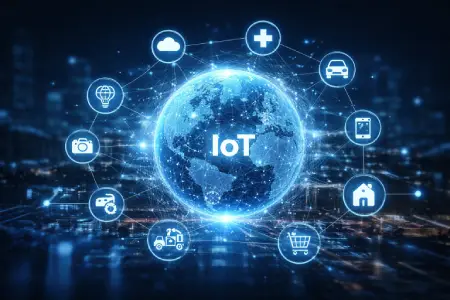
The Internet of Things (Internet of Things – IoT) is considered one of the most important concepts of digital transformation in the modern era. It refers to an integrated system that connects smart devices, machines, digital systems, and even living organisms through the Internet, enabling them to collect, exchange, and analyze data without direct human intervention.
This system relies on assigning each connected device or element a unique identifier (UID) or Internet Protocol address (IP), allowing it to communicate with other networks and systems intelligently and efficiently.
Real-World Examples of the Internet of Things
The Internet of Things extends to practical applications we see every day, including:
-
Vital signs monitoring devices such as heart sensors.
-
Animals equipped with smart chips to track health and production on farms.
-
Smart cars that alert the driver to low tire pressure or potential malfunctions.
-
Any natural or manufactured element that can connect to the Internet and send data in real time.
How Does the Internet of Things Work?
The IoT architecture relies on several interconnected layers, including:
-
Smart Devices: Equipped with sensors and microprocessors.
-
Network Connectivity: Via Wi-Fi, fifth-generation networks (5G), or LPWAN technologies.
-
IoT Gateways: For data transfer.
-
Cloud Computing: For data processing and analysis.
-
Artificial Intelligence and Machine Learning: For converting data into smart decisions.
In some cases, devices communicate directly with each other to take immediate action without referring to the cloud, in what is known as Edge Computing.
The Importance of the Internet of Things in Our Lives
The Internet of Things helps individuals live and work more intelligently, and provides better control over homes, health, and energy. At the corporate level, it is a strategic tool that enables:
-
Real-time monitoring of operations.
-
Improving operational efficiency.
-
Enhancing customer experience.
-
Supporting data-driven decision-making.
For this reason, the Internet of Things has become a fundamental element in the digital transformation of organizations.
Benefits of the Internet of Things for Organizations
IoT provides multiple competitive advantages, most notably:
-
Reducing operational costs.
-
Raising employee productivity.
-
Improving the quality of products and services.
-
Automating processes and reducing human errors.
-
Developing innovative business models.
-
Increasing revenues and promoting sustainable growth.
Uses of the Internet of Things in Various Sectors
🔹 Industry and Manufacturing
Monitoring machines, predictive maintenance, and improving supply chains.
🔹 Smart Agriculture
Collecting data on humidity, temperature, and soil, automating irrigation systems, and increasing production.
🔹 Healthcare
Remote patient monitoring, medical inventory management, and improving care quality.
🔹 Smart Homes and Cities
Reducing energy consumption, managing traffic, improving sanitation and public services.
🔹 Wearable Devices
Analyzing health data, enhancing public safety, and improving emergency response.
Pros and Cons of the Internet of Things
✅ Pros:
-
Accessing data from anywhere.
-
Improving communication between devices.
-
Automating tasks.
-
Reducing costs and increasing efficiency.
❌ Cons:
-
Increased security risks.
-
Big data management challenges.
-
Lack of unified standards across companies.
-
Possibility of complete system failure when a malfunction occurs.
Security and Privacy Challenges of the Internet of Things
With billions of devices connected to the Internet, IoT security has become one of the biggest challenges. Cyberattacks such as the Mirai attack in 2016 proved that unsecured devices can be used in massive attacks such as Distributed Denial of Service (DDoS).
Data privacy also poses a real risk, especially with the collection of sensitive information about users, which requires:
-
Regular security updates.
-
Data encryption.
-
Strict legislation to protect privacy.
The Future of the Internet of Things
Experts expect the Internet of Things to experience rapid growth supported by technologies such as:
-
Artificial intelligence.
-
Fifth-generation networks.
-
Edge computing.
-
Predictive analytics.
Making it one of the fundamental pillars of the global digital economy.
In light of this development, many technology enthusiasts rely on multiple sources to follow up on Arabic websites and specialized blogs, in addition to what is provided by Egypt stores and Kuwait stores and vitamin stores and foreign websites, while relying on Mashhor for social media services as a primary source of information and updates.
And here, dear brothers and sisters, we have successfully completed our mission ✌
Send blessings upon the Prophet, may your hearts find peace, and do good no matter how small 🎯🌷
Don't forget our brothers and sisters everywhere in your prayers 📌
Greetings from the team #Ezznology #Ezz_Technology
You can also browse the products of Our Store from here 👈#Our Store 🌷or here
To join our family on the Telegram Group from 👈here
Also the Facebook Group where we share information and help members from 👈here

Other topics you may also find interesting :
Machines Can Think Summit 2026 in Abu Dhabi
Reasons for the Failure of Online Stores in Egypt
Top Shipping and Delivery Companies in Egypt
Computer Ports and Network Ports
Google Unveils Veo 3.1 to Advance AI Video Production
Western Union Address in Alexandria